
High streamflow advisory update (Monday, June 1 at 12 p.m.)
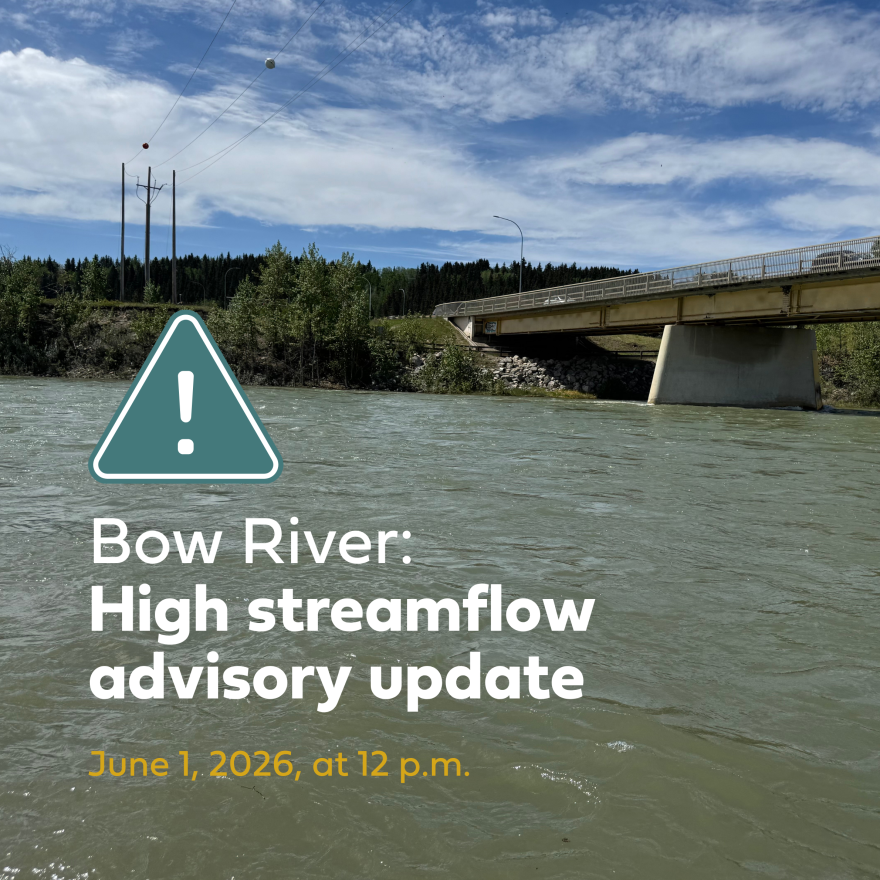
Recent rainfall has significantly increased flows on the Bow River, creating dangerous conditions along the river and its banks.
Currently, the Bow River has reached a flow of approximately 388 m³/second - well above the typical range of 150–250 m³/second for this time of year.
The Town of Cochrane has received reports of people getting too close to the water. Fast-moving water, unstable embankments, slippery shorelines and submerged debris continue to make the river unpredictable and hazardous. For your safety, please continue to use extreme caution.
The Town has also received questions about how current conditions compare to the 2013 flood. While the river is running high, flows remain well below those historic levels. During the 2013 flood, peak flows in the Calgary area reached approximately 1,840 m³/second, nearly five times higher than what we are seeing currently.
The Town will continue to monitor conditions and streamflow data from the Alberta River Forecast Centre and provide updates as needed.
If conditions worsen, emergency updates will be shared through the Town of Cochrane app and Alberta Emergency Alerts.
High streamflow advisory issued for the Bow River (Friday, May 29)
Water levels on the Bow River are expected to rise significantly over the coming days due to increased snowmelt and forecasted rainfall. A high streamflow advisory is in effect from upstream of Banff to Ghost Reservoir.
Residents are urged to use extreme caution near the river and avoid flooded areas, pathways and riverbanks. Fast-moving water, submerged debris, slippery banks and unstable embankments create dangerous conditions. What may appear to be solid ground can be undercut by water. Keep children and pets away from the water's edge and respect any pathway closures resulting from overland flooding.
Watercraft use on the Bow River is not recommended at this time.
If an emergency occurs on or near the river, call 911 immediately. Do not enter the water or attempt a rescue.
How to prepare
- Avoid riverbanks and low-lying areas where the river can submerge pathways.
- Keep children and pets away - fast moving water can erode riverbanks quickly.
- If you live in a low-lying area that’s at risk of flooding, take steps to be flood ready; move valuables and documents out of your basement.
- Don't forget to check your sump pump and backflow valve if you have one.
- Check your swale for debris or blockages.
- Clean out downspouts and ensure they are pointed away from your foundation.
- Rainfall can lead to pooling water on local streets; when a significant amount of rainwater accumulates on a street, it is likely located near a trap low; these are devices that control water drainage from streets.
- Water may accumulate up to a homeowners’ driveway and part of their lawn, but it should completely drain within 24 hours once the rain stops.
Neighbourhood stormwater management & water pooling
Some neighbourhoods are located near trap lows, which are designed as part of Cochrane's stormwater management system. These areas temporarily store runoff during heavy rain events, allowing water to collect on streets and nearby greenspaces while directing it safely away from homes and foundations. While water may appear to extend onto portions of driveways or lawns, trap lows are functioning as intended.
Trap lows in Cochrane